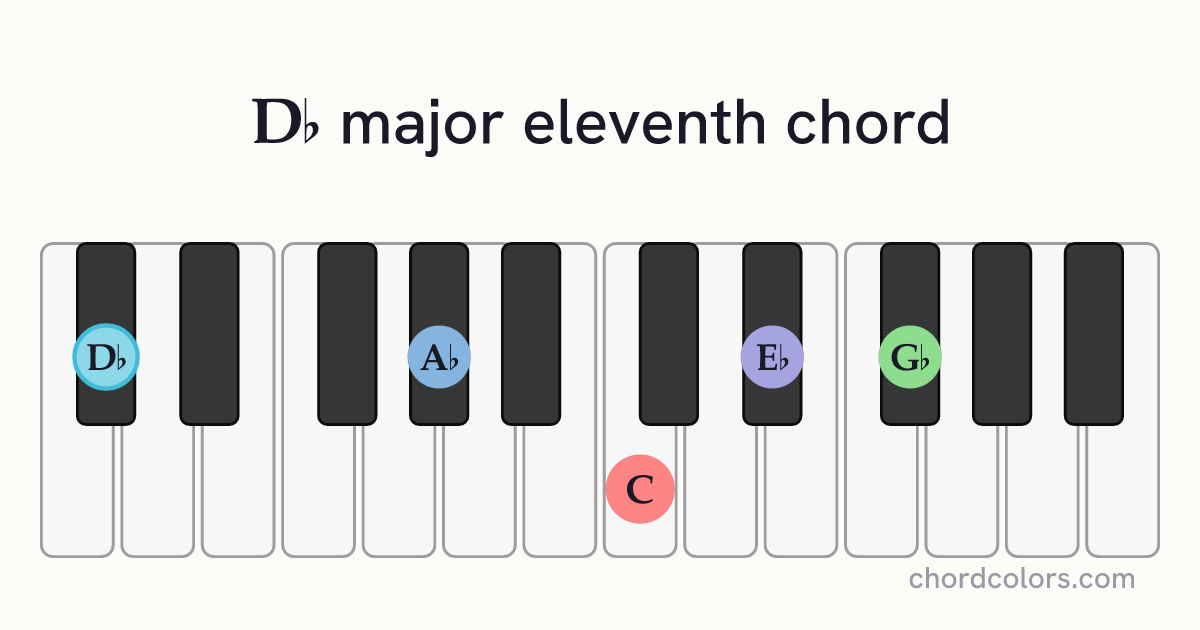
About the D flat major eleven chord
D flat major eleven is used in D flat Major, where every note it holds is a scale tone. Think of it as a D♭ major eleventh chord.
Its notes are D♭, A♭, C, E♭, and G♭. The intervals are a perfect fifth, a major seventh, a major ninth, and a perfect eleventh.
Also called Δ11 and M11. C sharp major eleven spells the same notes enharmonically. In shorthand it is commonly written Dbmaj11.
Inversions
D flat major eleven (root position)
Notes and intervals
| 1 | DbD♭ | Root |
|---|---|---|
| 2 | AbA♭ | Perfect 5th |
| 3 | CC | Major 7th |
| 4 | EbE♭ | Major 9th |
| 5 | GbG♭ | Perfect 11th |
Shapes
Chromatic
Circle of Fifths
Other D flat chords
Simpler triads
Suspended
Sixths and sevenths
Extensions
Altered
Functional relationships
These chords are where this one most naturally comes from and resolves to inside a key.
Relative minor
The relative minor uses the same notes and key signature, so it works as a calmer, darker home base.
Parallel minor
The parallel minor keeps the same root note but lowers the third, giving the same key a darker, sadder sound.
Dominant
The dominant is a fifth above the root, and it builds tension that pulls strongly back to this chord.
Subdominant
The subdominant is a fourth above the root (a fifth below), and it usually leads on to the dominant or back home.
Tritone substitution
The tritone substitution stands in for this chord's dominant with a dominant seventh a half step above the root, which slides down by a half step to resolve here.
Embed this chord