Common
About the D sharp Natural Minor scale
D sharp Natural Minor is used for ballads, cinematic themes and emotional rock and pop. Think of it as the classic sad, serious minor sound. It is D♯ Dorian with the sixth lowered.
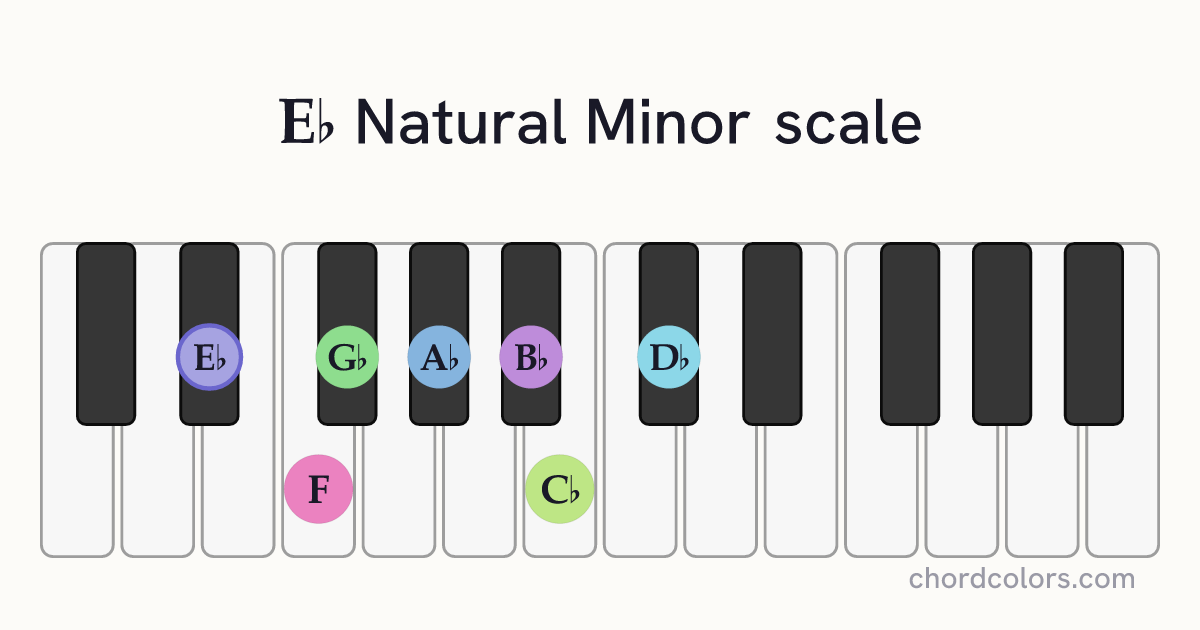
Its notes are D♯, E♯, F♯, G♯, A♯, B, and C♯. The formula is W H W W H W W. It is the sixth mode of F♯ Major.
Also called the Aeolian mode, Melodic Minor Descending, and Asavari. The descending form of the melodic minor scale uses these same notes.
On the piano, this scale touches the black keys D♯, F♯, G♯, A♯, and C♯.
Chords in the key of D sharp Natural Minor
Expand a chord to see how to play it.
Position 2 of 3
D sharp minor over F sharp (1st inversion)
Position 2 of 3
E sharp diminished over G sharp (1st inversion)
Position 2 of 3
F sharp over A sharp (1st inversion)
Position 2 of 3
G sharp minor over B (1st inversion)
Position 2 of 3
A sharp minor over C sharp (1st inversion)
Position 2 of 3
B over D sharp (1st inversion)
Position 2 of 3
C sharp over E sharp (1st inversion)
Seventh chords in D sharp Natural Minor
The four-note version of each chord, richer and jazzier.
D sharp minor seven
E sharp minor seven flat five
F sharp major seven
G sharp minor seven
A sharp minor seven
B major seven
C sharp seven
Progressions in D sharp Natural Minor
Tap any chord to hear it, or play the whole progression.
Common
Notes and intervals
| 1 | D#D♯ | Root |
|---|---|---|
| 2 | E#E♯ | Major 2nd |
| 3 | F#F♯ | Minor 3rd |
| 4 | G#G♯ | Perfect 4th |
| 5 | A#A♯ | Perfect 5th |
| 6 | BB | Minor 6th |
| 7 | C#C♯ | Minor 7th |
| Steps | W H W W H W W |
|---|---|
| Semitones | 2-1-2-2-1-2-2 |
| Degrees | 1 2 ♭3 4 5 ♭6 ♭7 |
Fingering
Standard fingering
| Hand | D sharp | E sharp | F sharp | G sharp | A sharp | B | C sharp | D sharp |
|---|---|---|---|---|---|---|---|---|
| Right hand | 3 | 1 | 2 | 3 | 4 | 1 | 2 | 3 |
| Left hand | 2 | 1 | 4 | 3 | 2 | 1 | 3 | 2 |
Practicing it
The right hand changes position on E♯ and B, where the thumb crosses under. The left thumb lands on E♯ and B, and the hand crosses back over it from there. E♯ and B carry the thumb in both hands, which keeps the two crossings lined up. D♯, F♯, G♯, A♯, and C♯ are the black keys the long fingers take, and the fourth finger anchors the shape on A♯, which is what keeps the thumb clear of them.
Shapes
Chromatic
Circle of Fifths
Related scales
Natural Minor in other keys
C Natural Minor scaleC sharp Natural Minor scaleD Natural Minor scaleE Natural Minor scaleF Natural Minor scaleF sharp Natural Minor scaleG Natural Minor scaleG sharp Natural Minor scaleA Natural Minor scaleA sharp Natural Minor scaleB Natural Minor scale
Modes
The same notes, starting on a different note.
Embed this scale